
COMING SOON Awaiting UAE License
PRODUCTS SOLD ON PEPTIDESLABUAE.COM ARE FOR RESEARCH PURPOSES ONLY AND ARE NOT FOR HUMAN OR VETERINARY USE.
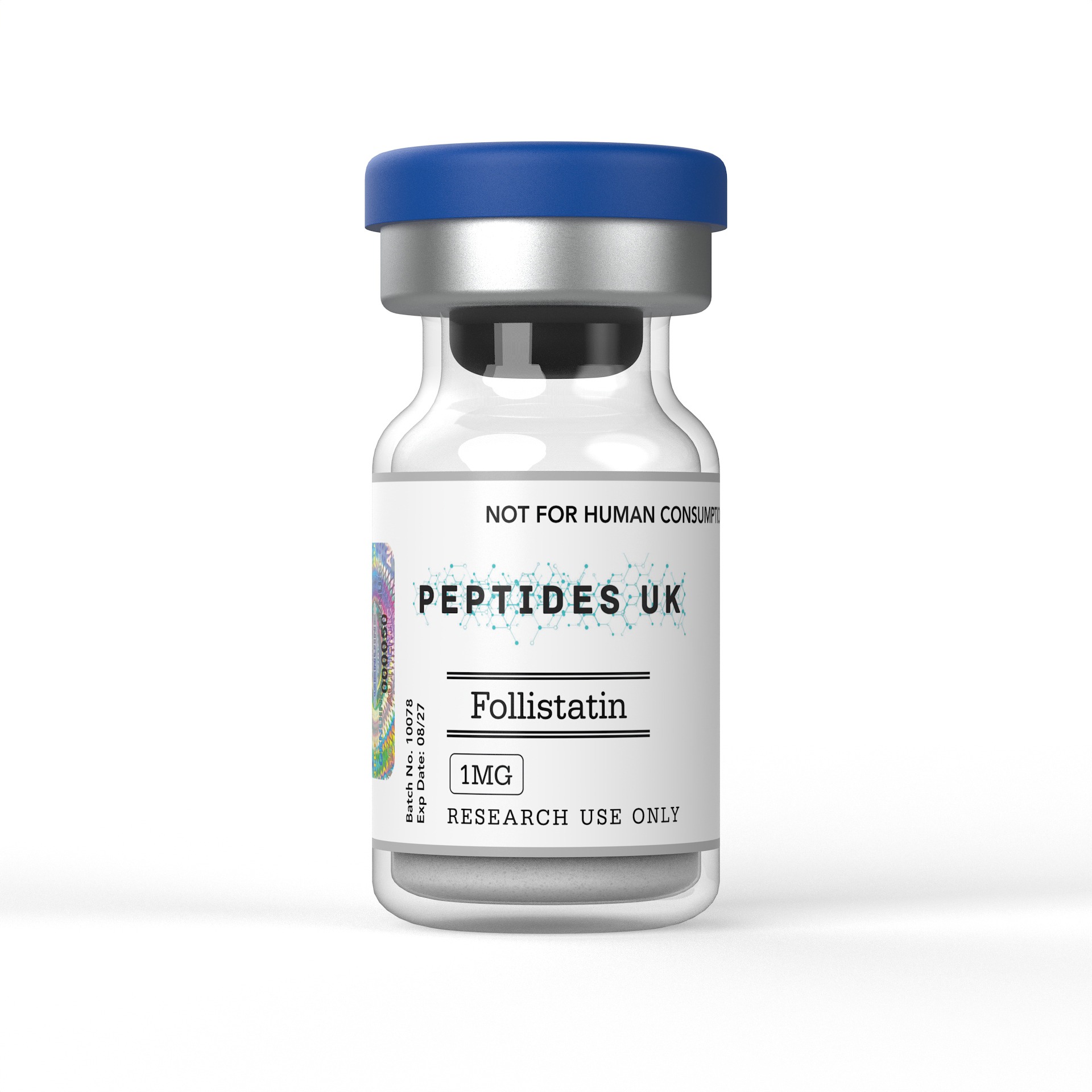
$306.00
Buy Follistatin Peptide in UAE – In Stock & Ready to Ship
Follistatin is a widely researched peptide known for its role in muscle growth regulation and myostatin inhibition studies. Each batch is independently verified at ≥99% purity and comes with a full Certificate of Analysis (COA) and HPLC testing documentation — giving UAE research teams the confidence they need when sourcing peptides for serious work.
For research use only. Not intended for human or veterinary use.

Follistatin is a naturally occurring glycoprotein studied extensively in muscle biology, reproductive endocrinology, and developmental research for its role as a potent inhibitor of myostatin and activin — proteins that suppress muscle growth and regulate reproductive hormone signalling — making it one of the most significant regulatory proteins in skeletal muscle research and one of the most studied endogenous growth regulators in pre-clinical science. Researchers and institutions across the UAE, Dubai, Abu Dhabi and the wider GCC can source verified, research-grade Follistatin with fast international dispatch and full batch documentation included.
✅ ≥99% Purity — HPLC & Mass Spectrometry Verified
✅ Batch-Specific Certificate of Analysis (CoA) Included
✅ Sterile Lyophilised Powder | GMP Manufactured
✅ Fast International Dispatch to UAE & GCC
Follistatin is an endogenous single-chain glycoprotein originally identified as a follicle-stimulating hormone (FSH) suppressing protein isolated from ovarian follicular fluid — which is where its name originates. Since its initial characterisation, research has revealed that its most significant biological role extends far beyond reproductive hormone regulation to include the potent inhibition of myostatin — a member of the TGF-β (transforming growth factor beta) superfamily that acts as the body’s primary brake on muscle growth.
Follistatin is available in several isoforms — the most studied in research being Follistatin-344 (FS-344) and Follistatin-288 (FS-288), which differ in their C-terminal sequences and resulting binding characteristics. Follistatin-344 is the predominant circulating form and the most widely used in research settings. It acts by directly binding to and neutralising myostatin, activin, and other TGF-β family members — preventing these proteins from engaging their receptors and exerting their growth-suppressive and reproductive regulatory effects.
Its dual role in both muscle biology and reproductive endocrinology, combined with growing research interest in myostatin inhibition as a tool for studying muscle growth regulation, has made Follistatin one of the most sought-after research proteins in pre-clinical science. Research demand from institutions across the UAE and GCC continues to grow alongside expanding programmes in muscle biology, sports science research, and reproductive endocrinology.
In controlled laboratory and pre-clinical research settings, Follistatin has been studied across a broad range of muscle biology, endocrinology, and developmental research applications:
Myostatin Inhibition Research: Follistatin’s most studied and impactful research application is its potent inhibition of myostatin — the primary negative regulator of skeletal muscle mass. Studies use Follistatin to examine what happens to muscle cell biology when myostatin signalling is blocked, exploring the downstream effects on muscle fibre size, satellite cell activity, and protein synthesis in cellular and animal models.
Skeletal Muscle Biology: Research has examined Follistatin’s effects on skeletal muscle tissue across multiple pre-clinical models — including studies on muscle fibre hypertrophy, satellite cell proliferation and differentiation, myotube formation, and overall muscle mass regulation under Follistatin-mediated myostatin inhibition.
Activin Inhibition Research: Beyond myostatin, Follistatin also inhibits activins — a related TGF-β family with roles in reproductive biology, inflammation, and cellular differentiation. Studies have examined how Follistatin’s activin-neutralising activity influences these processes in both reproductive and non-reproductive tissue models.
FSH Regulation Research: Follistatin’s original identification as an FSH suppressor has maintained its relevance in reproductive endocrinology research. Studies have examined how Follistatin influences FSH secretion from the pituitary, ovarian follicle development, and the broader hormonal regulation of the hypothalamic-pituitary-gonadal axis.
Reproductive Biology Studies: Research has incorporated Follistatin into models examining ovarian function, folliculogenesis, uterine biology, and male reproductive tissue — reflecting activin’s widespread roles in reproductive endocrinology and Follistatin’s role as its primary endogenous inhibitor.
TGF-β Pathway Research: As a broad inhibitor of TGF-β superfamily members, Follistatin is used as a research tool for studying how blockade of this signalling family influences cellular behaviour across multiple tissue types including bone, adipose tissue, and immune cells.
Bone and Connective Tissue Research: Activin and myostatin both influence bone and connective tissue biology. Studies have examined Follistatin’s effects on osteoblast activity, bone density markers, and connective tissue remodelling in pre-clinical models — reflecting the broader regulatory role of TGF-β family inhibition in musculoskeletal biology.
Adipose Tissue Research: Studies have examined Follistatin’s influence on fat cell behaviour and adipose tissue biology — exploring how myostatin and activin inhibition affects energy balance between muscle and fat tissue compartments in metabolic research models.
Inflammatory Regulation: Activins play roles in inflammatory signalling, and research has examined Follistatin’s anti-inflammatory properties in models where activin-driven inflammation is a feature — contributing to a broader understanding of TGF-β superfamily regulation in immune biology.
All applications listed are research-based only. Follistatin is not approved for human therapeutic use.
Follistatin has accumulated an extensive and high-impact research profile particularly in muscle biology and reproductive science:
Muscle biology research has produced some of the most striking findings in Follistatin’s research literature — with landmark pre-clinical studies demonstrating that genetic overexpression of Follistatin in animal models produces dramatic increases in skeletal muscle mass through myostatin inhibition, with some studies reporting muscle mass increases of over 100% in certain muscle groups compared to controls — establishing Follistatin-mediated myostatin inhibition as one of the most potent muscle growth regulatory mechanisms identified in biology. Myostatin inhibition studies using recombinant Follistatin protein have confirmed these effects in both cellular and animal models, with research documenting dose-dependent increases in muscle fibre cross-sectional area, satellite cell activity, and muscle protein content under Follistatin treatment conditions. Reproductive endocrinology research has characterised Follistatin’s role in FSH regulation and ovarian biology, with studies examining how Follistatin expression levels in pituitary and ovarian tissue influence reproductive hormone dynamics and follicle development across different reproductive states. Activin inhibition research has expanded understanding of Follistatin’s biological reach beyond muscle and reproduction, with studies documenting its anti-inflammatory properties, its influence on pancreatic beta cell function, and its role in bone metabolism — establishing it as a broader biological regulator than initially characterised. Comparative studies examining Follistatin-344 versus Follistatin-288 have provided insights into how the different isoforms’ binding characteristics affect their activity profiles in different tissue environments — with FS-344 demonstrating broader binding activity and FS-288 showing more restricted tissue distribution.
| Feature | Follistatin-344 | Follistatin-288 |
|---|---|---|
| Isoform | FS-344 (predominant circulating form) | FS-288 (tissue-bound form) |
| C-Terminal Sequence | Full acidic domain present | Acidic domain truncated |
| Heparin Binding | Lower affinity | Higher affinity (tissue-binding) |
| Circulating Activity | Yes | Limited (tissue-restricted) |
| Primary Research Use | Systemic myostatin/activin inhibition | Local tissue-bound activity |
| FSH Suppression | Yes | Less pronounced |
| Most Common in Research | Yes | Specialised applications |
| Parameter | Specification |
|---|---|
| Isoform | Follistatin-344 (FS-344) |
| Origin | Recombinant human Follistatin |
| Primary Targets | Myostatin, Activin A/B, TGF-β family |
| Purity | ≥99% (HPLC & MS Verified) |
| Form | Sterile Lyophilised Powder |
| Solubility | Sterile water, PBS, standard aqueous buffers |
| Storage (powder) | -20°C, protect from light |
| Storage (reconstituted) | 2–8°C, use within 2–4 weeks |
Every order of Follistatin dispatched to the UAE and GCC includes:
Can I buy Follistatin in the UAE?
Yes. We supply research-grade Follistatin-344 with international dispatch to the UAE, Dubai, Abu Dhabi, Sharjah and across the GCC. All orders include full batch documentation and are packaged to maintain protein integrity throughout transit. This compound is supplied strictly for laboratory research use only.
What is myostatin and why is its inhibition by Follistatin so significant in research?
Myostatin is a protein produced primarily by skeletal muscle cells that acts as a potent inhibitor of muscle growth — essentially a biological brake that prevents excessive muscle hypertrophy. It is a member of the TGF-β superfamily and exerts its effects by binding to activin receptors on muscle cells, triggering signalling cascades that suppress protein synthesis and satellite cell activity. Follistatin is its primary endogenous inhibitor — binding directly to myostatin and preventing receptor engagement. Research examining Follistatin-mediated myostatin inhibition has produced some of the most dramatic muscle growth findings in pre-clinical biology, making this research axis one of the most actively studied areas in muscle physiology.
What is the difference between Follistatin-344 and Follistatin-288?
Both are naturally occurring isoforms of Follistatin produced through alternative mRNA splicing, but they differ in their C-terminal sequences and resulting tissue distribution. Follistatin-344 contains a full acidic C-terminal domain that reduces heparin binding — allowing it to circulate in biological fluids and exert systemic effects. Follistatin-288 has a truncated C-terminal domain that increases heparin binding affinity — restricting it to local tissue-bound activity. For most research applications examining systemic myostatin or activin inhibition, Follistatin-344 is the preferred and more widely used isoform.
Does Follistatin only affect muscle tissue in research?
No — while muscle biology is Follistatin’s most studied research application, its role as a broad TGF-β superfamily inhibitor means it has documented activity across multiple tissue types. Research has examined its effects on reproductive tissue through FSH and activin regulation, bone tissue through osteoblast activity, adipose tissue through metabolic interactions with muscle, and immune tissue through activin’s inflammatory roles. This breadth makes Follistatin a comprehensive research tool for laboratories studying TGF-β family biology beyond muscle research alone.
What purity is required for Follistatin muscle biology research?
A minimum of ≥98% is considered research grade for recombinant proteins, though ≥99% is strongly preferred for sensitive myostatin binding assays, cell-based muscle studies, and receptor inhibition experiments. All our Follistatin is independently verified to ≥99% purity with full structural confirmation.
How is Follistatin reconstituted for laboratory use?
Allow the vial to reach room temperature before opening. Add sterile water or PBS slowly down the vial wall and allow to dissolve by gentle swirling — do not shake vigorously as this can cause protein aggregation. Aliquot immediately and store at -80°C for longer-term use, or at 2–8°C for short-term experiments within 2–4 weeks. Avoid repeated freeze-thaw cycles to maintain protein structural integrity and binding activity.
How quickly is Follistatin delivered to UAE?
Orders are dispatched promptly via tracked international courier. Delivery to the UAE typically takes 3–5 working days, with cold-chain packaging designed to maintain protein stability throughout transit.
Research Disclaimer: Follistatin is supplied exclusively for legitimate scientific research purposes conducted within licensed laboratory environments. This product is not intended for human consumption, self-administration, or any therapeutic application. It must be handled by qualified researchers in compliance with applicable UAE regulations and institutional ethics guidelines. Handling should only be performed by qualified laboratory professionals in controlled research settings with appropriate institutional authorisations in place. By purchasing, you confirm that this compound will be used solely for approved in-vitro or pre-clinical research purposes.
Receive News
