
PRODUCTS SOLD ON PEPTIDESLABUAE.COM ARE FOR RESEARCH PURPOSES ONLY AND ARE NOT FOR HUMAN OR VETERINARY USE.
£79.00
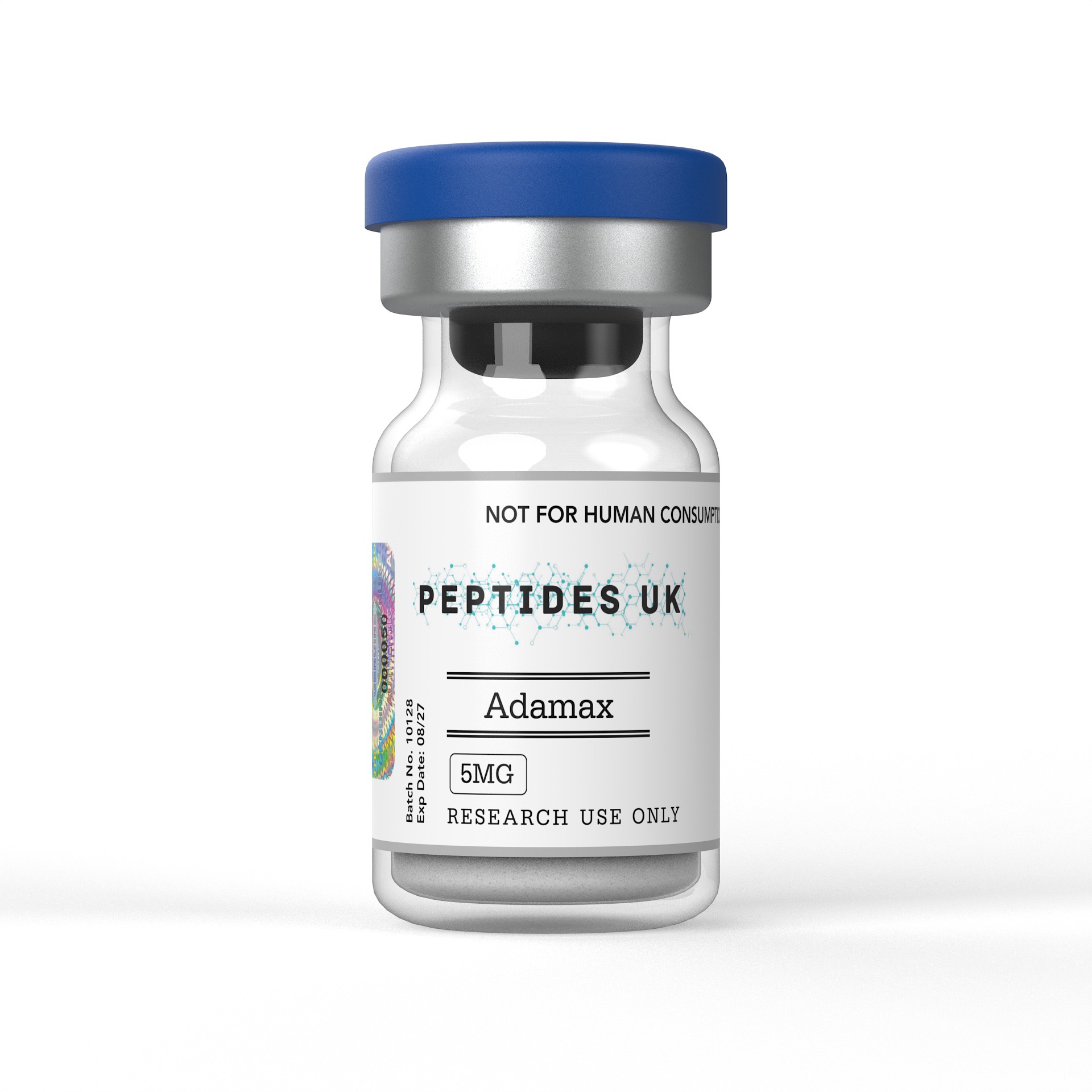
Buy Adamax in UAE – In Stock & Ready to Ship
Adamax is a widely researched compound known for its role in neuroprotective function and cognitive enhancement studies. Each batch is independently verified at ≥99% purity and comes with a full Certificate of Analysis (COA) and HPLC testing documentation — giving UAE research teams the confidence they need when sourcing compounds for serious work.
For research use only. Not intended for human or veterinary use.

Adamax (Desmopressin with adamantane modification) — also referenced in research contexts as a next-generation vasopressin receptor-targeting peptide — is one of the most specifically engineered synthetic vasopressin analogues available to laboratories in the UAE, combining selective V1b/V2 receptor engagement with enhanced metabolic stability through adamantane structural modification to produce a research compound of significant interest for studying vasopressin receptor pharmacology, HPA axis stress response regulation, memory consolidation and cognitive biology, renal water homeostasis mechanisms, and the intersection of neuropeptide signalling with neuroendocrine stress circuitry. Researchers and institutions across the UAE, Dubai, Abu Dhabi and the wider GCC can source verified, research-grade Adamax with fast international dispatch and full batch documentation included.
✅ ≥99% Purity — HPLC & Mass Spectrometry Verified
✅ Batch-Specific Certificate of Analysis (CoA)
✅ Sterile Lyophilised Powder | GMP Manufactured
✅ Fast International Dispatch to UAE & GCC
Adamax is a synthetic vasopressin analogue peptide incorporating an adamantane moiety — a cage-shaped polycyclic hydrocarbon structure widely used in medicinal chemistry to enhance compound metabolic stability, membrane permeability, and receptor binding geometry. In the context of vasopressin analogue research, the adamantane modification is applied to the neuropeptide scaffold to improve resistance against enzymatic degradation — particularly by vasopressinase and other peptidases that rapidly inactivate native vasopressin and limit its research utility in extended protocols — while preserving or enhancing receptor binding affinity at the vasopressin receptor subtypes most relevant to the research application.
Vasopressin (Arginine Vasopressin, AVP) is a nine amino acid cyclic neuropeptide — structurally closely related to oxytocin, differing by only two amino acids — produced in the hypothalamic paraventricular nucleus (PVN) and supraoptic nucleus (SON) and acting through three G-protein coupled receptor subtypes: V1a receptors mediating cardiovascular and social behaviour effects, V1b receptors mediating HPA axis stress response regulation through pituitary ACTH release stimulation, and V2 receptors mediating renal water reabsorption and antidiuretic effects. The precise receptor subtype engagement profile of Adamax — determined by the specific adamantane modification position and the peptide backbone sequence — makes it a targeted research tool for studying specific vasopressin receptor subtype biology with improved pharmacokinetic characteristics compared to native AVP.
The adamantane modification strategy in neuropeptide research reflects a broader medicinal chemistry approach — adding the bulky lipophilic adamantane cage to peptide structures to simultaneously improve metabolic stability, enhance membrane penetration for central nervous system research applications, and in some cases fine-tune receptor subtype selectivity through steric effects on receptor binding pocket interactions. These properties make Adamax-type vasopressin analogues particularly relevant for pre-clinical research examining vasopressin receptor pharmacology in intact biological systems where native AVP’s short half-life limits experimental design options.
In laboratory settings, Adamax research is centred on its vasopressin receptor engagement with the pharmacokinetic advantages conferred by adamantane modification. Research applications include:
Its adamantane-enhanced metabolic stability — providing extended research utility in biological systems compared to native AVP — makes Adamax a practical research tool for studying vasopressin receptor biology in extended pre-clinical protocols requiring sustained receptor engagement. All applications are for research use only.
Adamax and related adamantane-modified vasopressin analogues occupy a focused and growing research space within vasopressin receptor pharmacology and neuropeptide medicinal chemistry:
Adamantane modification research in neuropeptide chemistry has characterised how the bulky polycyclic adamantane cage influences peptide metabolic stability — with studies documenting significantly enhanced resistance to vasopressinase and other peptidase-mediated degradation compared to native AVP and unmodified vasopressin analogues. These stability improvements translate directly to extended biological activity windows in research models — a critical practical advantage for pre-clinical studies requiring consistent vasopressin receptor engagement across multi-hour or multi-day experimental protocols.
Vasopressin receptor pharmacology research has used adamantane-modified analogues to examine how the structural modification influences receptor subtype binding profiles — with studies characterising changes in V1a, V1b, and V2 receptor affinity resulting from adamantane incorporation at different positions in the vasopressin scaffold. These SAR studies have contributed to the broader understanding of how bulky lipophilic modifications influence vasopressin receptor pocket accommodation and have informed the rational design of improved vasopressin analogue research tools.
HPA axis stress research has examined vasopressin receptor biology as a central component of stress neuroendocrinology — with studies characterising V1b receptor-mediated ACTH release from pituitary corticotroph cells alongside CRH as the two primary hypothalamic drivers of HPA axis activation. Research using vasopressin analogues with improved metabolic stability has provided insights into how vasopressin’s contribution to HPA axis activation interacts with CRH under acute and chronic stress conditions — making enhanced-stability vasopressin analogues important research tools for studying stress neuroendocrinology in extended pre-clinical protocols.
Memory and cognitive biology research has drawn on the well-established connection between vasopressin signalling and memory consolidation — with studies documenting effects of vasopressin receptor activation on hippocampal function, long-term potentiation, and spatial memory parameters in pre-clinical models. Vasopressin analogues with improved metabolic stability provide more consistent receptor engagement in cognitive research protocols — enabling cleaner experimental designs for studying how vasopressin receptor pharmacology influences memory biology.
Neuropeptide medicinal chemistry research has used adamantane-modified peptides more broadly as a platform for studying how cage hydrocarbon modifications influence the physicochemical and pharmacological properties of bioactive peptides — with findings applicable across multiple neuropeptide classes beyond vasopressin. These structural biology studies have established adamantane modification as a validated research strategy for improving neuropeptide research tool practicality.
| Compound | Type | Primary Receptors | Half-Life | Key Research Focus | Research Profile |
|---|---|---|---|---|---|
| Adamax | Adamantane-modified vasopressin analogue | V1b/V2 — profile dependent on modification | Extended vs AVP | Vasopressin pharmacology, HPA axis, stability | Growing |
| Native AVP (Vasopressin) | Endogenous nonapeptide | V1a + V1b + V2 | ~minutes | Reference vasopressin biology | Extensively studied |
| Desmopressin (DDAVP) | V2-selective analogue | V2 selective | ~1–2 hours | Renal water homeostasis, V2 pharmacology | Extensively studied |
| Terlipressin | V1a-selective prodrug | V1a selective | ~6 hours | Cardiovascular vasopressin research | Well-documented |
| SSR149415 | V1b antagonist | V1b selective antagonist | Variable | HPA axis, stress research | Well-documented |
| Oxytocin | Endogenous nonapeptide | OXTR (+ V1a/V1b cross) | ~minutes | Social behaviour, reproduction | Extensively studied |
| Parameter | Detail |
|---|---|
| Type | Synthetic Adamantane-Modified Vasopressin Analogue |
| Modification | Adamantane moiety — metabolic stability enhancement |
| Receptor Targets | Vasopressin receptor subtypes (V1b/V2 profile) |
| Key Advantage | Enhanced metabolic stability vs native AVP |
| Purity | ≥99% |
| Verification | HPLC & Mass Spectrometry |
| Form | Lyophilised Powder |
| Solubility | Sterile water or suitable laboratory buffer |
| Storage | -20°C, protected from light and moisture |
| Intended Use | Research use only |
Every order dispatched to the UAE and GCC includes:
Yes. We supply research-grade Adamax with international dispatch to the UAE, Dubai, Abu Dhabi, Sharjah and across the GCC. All orders include full batch documentation and are packaged to maintain peptide integrity throughout transit. This compound is supplied strictly for laboratory research use only.
Adamantane is a cage-shaped polycyclic hydrocarbon — a compact, rigid, and highly symmetric structure that has been widely adopted in medicinal chemistry as a metabolic stability-enhancing modification for bioactive compounds. When incorporated into peptide research tools, adamantane contributes improved resistance against enzymatic degradation by creating steric hindrance around cleavage sites and introducing lipophilic bulk that can enhance membrane permeability for CNS research applications. In vasopressin analogue research specifically, adamantane modification addresses native AVP’s very short half-life — enabling extended biological activity windows that allow more practical pre-clinical research protocol designs without compromising receptor engagement specificity.
The three vasopressin receptor subtypes have distinct tissue distributions and biological functions that make each a distinct research target. V1a receptors are expressed in vascular smooth muscle, liver, and brain — mediating cardiovascular vasoconstriction and social behaviour modulation, and sharing some cross-reactivity with oxytocin receptors that makes V1a pharmacology relevant to social neuroscience research. V1b receptors are expressed primarily in pituitary corticotroph cells — mediating ACTH release stimulation as the second major HPA axis activator alongside CRH, making V1b pharmacology central to stress neuroendocrinology research. V2 receptors are expressed in renal collecting duct cells — mediating aquaporin-2 insertion and water reabsorption, making V2 pharmacology central to water homeostasis and antidiuretic research.
The HPA axis stress response is driven by two primary hypothalamic signals — CRH and vasopressin — acting synergistically on pituitary V1b receptors to stimulate ACTH release, which in turn drives adrenal cortisol production. Research has established that vasopressin’s V1b-mediated contribution to HPA axis activation becomes increasingly significant under conditions of chronic stress — with V1b receptor upregulation amplifying pituitary sensitivity to vasopressin as stress chronifies. Adamax-type vasopressin analogues with improved metabolic stability enable more consistent V1b receptor engagement in chronic stress research protocols — providing research tools better suited to studying vasopressin’s contribution to HPA axis dysregulation in extended pre-clinical stress models.
Desmopressin (DDAVP) is the most widely used vasopressin analogue in research and clinical settings — a V2-selective analogue with minimal V1a activity, primarily used for studying renal water homeostasis and antidiuretic biology. Adamax differs in its adamantane modification strategy and receptor subtype engagement profile — providing a research tool for studying vasopressin receptor pharmacology with enhanced metabolic stability characteristics. While Desmopressin’s V2 selectivity makes it the reference compound for renal vasopressin biology, Adamax-type modifications address the broader vasopressin receptor subtype pharmacology space with improved stability — making the two compounds complementary rather than competing research tools for different aspects of vasopressin biology.
Vasopressin has a well-documented role in memory consolidation and cognitive function — with research characterising vasopressin receptor expression in hippocampal and cortical regions involved in memory formation and retrieval. Studies using vasopressin analogues have examined effects on long-term potentiation, spatial memory parameters, and social recognition memory in pre-clinical models — with vasopressin receptor activation consistently associated with enhanced memory consolidation in multiple learning paradigms. The availability of metabolically stable vasopressin analogues like Adamax provides improved research tools for studying vasopressin’s cognitive effects in extended protocols — enabling cleaner experimental designs for examining how sustained vasopressin receptor engagement influences hippocampal-dependent memory biology.
Allow the vial to reach room temperature before opening. Add sterile water or appropriate laboratory buffer slowly down the vial wall and swirl gently without shaking. Prepare at your protocol’s required concentration. The adamantane modification provides enhanced proteolytic stability compared to native AVP — however standard peptide handling protocols should be followed to preserve biological activity. Aliquot and store at -80°C to minimise freeze-thaw degradation and maintain peptide integrity between experimental sessions.
Orders are dispatched promptly via tracked international courier. Delivery to the UAE typically takes 3–5 working days, with packaging designed to maintain peptide stability and integrity throughout transit.
Adamax is supplied exclusively for legitimate scientific research conducted within licensed laboratory environments. This product is not intended for human consumption, self-administration, or any therapeutic or veterinary application. It must be handled solely by qualified researchers in compliance with applicable UAE regulations and institutional ethics guidelines. By purchasing, you confirm this compound will be used exclusively for approved in vitro or pre-clinical research purposes.
WhatsApp us
Receive News
