
PRODUCTS SOLD ON PEPTIDESLABUAE.COM ARE FOR RESEARCH PURPOSES ONLY AND ARE NOT FOR HUMAN OR VETERINARY USE.
£69.00
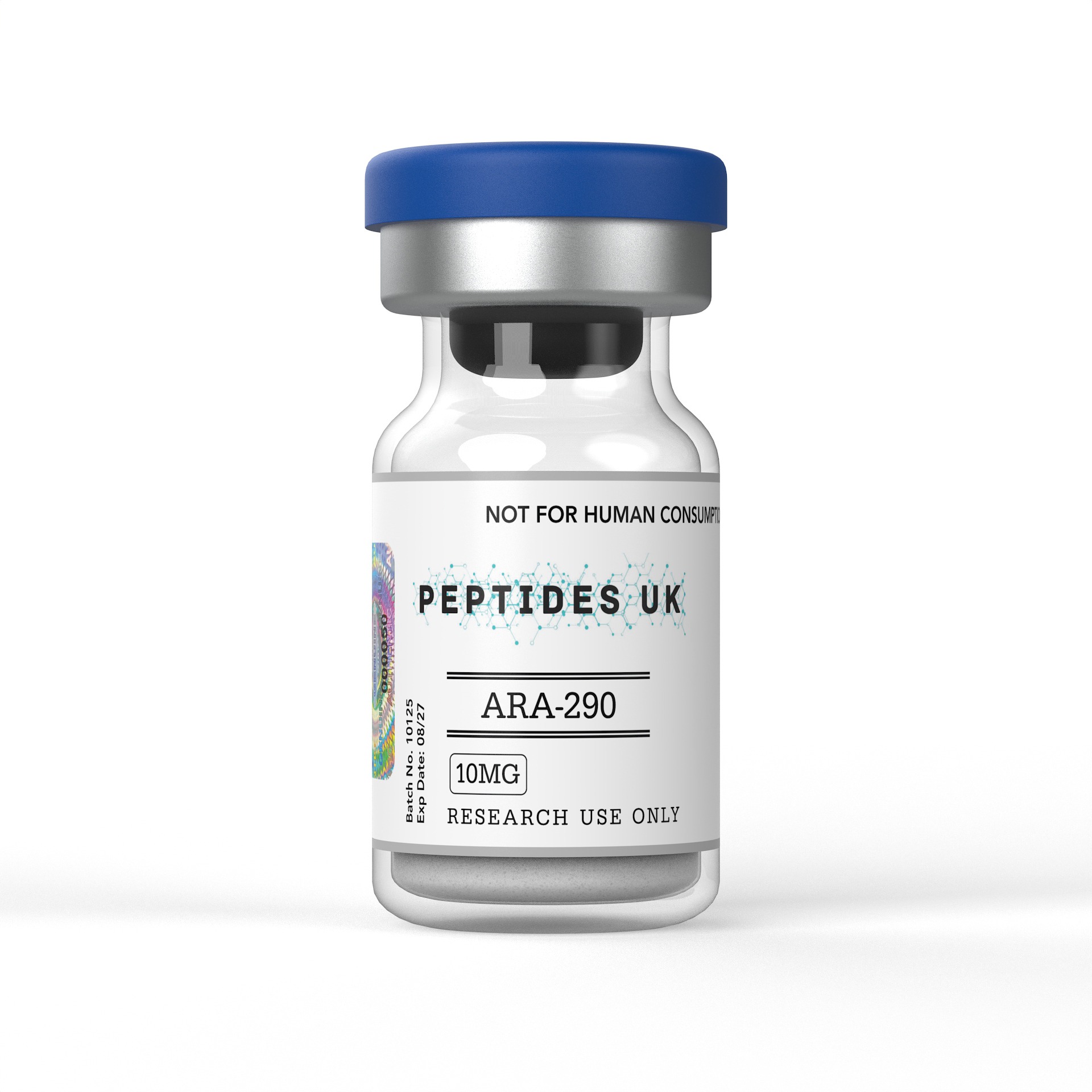
Buy ARA-290 Peptide in UAE – In Stock & Ready to Ship
ARA-290 is a widely researched peptide known for its role in neuroprotective function and tissue repair studies. Each batch is independently verified at ≥99% purity and comes with a full Certificate of Analysis (COA) and HPLC testing documentation — giving UAE research teams the confidence they need when sourcing peptides for serious work.
For research use only. Not intended for human or veterinary use.

ARA-290 is one of the most compelling synthetic peptides in neuroprotection and anti-inflammatory research available to laboratories in the UAE — an 11 amino acid cyclic peptide derived from the helix B surface of erythropoietin (EPO) that selectively activates the innate repair receptor (IRR) without engaging the classical erythropoietin receptor, making it a uniquely targeted research tool for studying tissue protection, neuropathic pain signalling, and anti-inflammatory pathway modulation independently of EPO’s haematopoietic effects. Researchers and institutions across the UAE, Dubai, Abu Dhabi and the wider GCC can source verified, research-grade ARA-290 with fast international dispatch and full batch documentation included.
✅ ≥99% Purity — HPLC & Mass Spectrometry Verified
✅ Batch-Specific Certificate of Analysis (CoA)
✅ Sterile Lyophilised Powder | GMP Manufactured
✅ Fast International Dispatch to UAE & GCC
ARA-290 is a synthetic cyclic 11 amino acid peptide derived from the helix B region of erythropoietin — a segment of EPO’s structure that is spatially distinct from the receptor-binding domains responsible for EPO’s classical haematopoietic (red blood cell stimulating) activity. This structural distinction is central to ARA-290’s research value: by mimicking helix B while avoiding the erythropoietic receptor binding sites, ARA-290 selectively engages what researchers have identified as the innate repair receptor (IRR) — a heteroreceptor complex distinct from the classical homodimeric EPO receptor.
The innate repair receptor is expressed across a wide range of non-haematopoietic tissues including neural tissue, immune cells, pancreatic beta cells, and various organ systems — and is understood to mediate EPO’s tissue-protective, anti-inflammatory, and cytoprotective effects that are entirely separate from its role in red blood cell production. ARA-290’s selective IRR engagement without erythropoietic activity makes it an exceptionally clean research tool for studying EPO’s non-haematopoietic biology — allowing researchers to examine tissue protection and anti-inflammatory signalling without the confounding haematological variables associated with full EPO administration.
Its cyclic structure confers improved stability compared to linear peptides of equivalent length, and its well-defined sequence and mechanism have made it one of the most referenced EPO-derived research peptides in current neuroprotection, metabolic, and inflammatory biology research.
In laboratory settings, ARA-290 research is centred on its selective IRR activation and the downstream tissue-protective and anti-inflammatory effects this produces in experimental models. Research applications include:
Its clean separation of tissue-protective IRR signalling from erythropoietic activity makes ARA-290 the most precise research tool available for isolating EPO’s cytoprotective biology from its haematological pharmacology. All applications are for research use only.
ARA-290 has developed one of the most distinctive and rapidly advancing research profiles among EPO-derived synthetic peptides:
Innate repair receptor research has characterised ARA-290’s selective engagement of the IRR complex — distinguishing its signalling profile from classical EPO receptor activation and establishing it as a tool for studying the tissue-protective arm of EPO biology in isolation. Studies have documented IRR expression across neural, immune, and metabolic tissues, providing the mechanistic foundation for ARA-290’s broad tissue-protection research applications.
Neuropathic pain and small fibre neuropathy research has produced some of the most clinically referenced findings associated with ARA-290 — with pre-clinical studies documenting significant effects on corneal nerve fibre density, intraepidermal nerve fibre parameters, and neuropathic pain behavioural markers in animal models of peripheral neuropathy. These studies have positioned ARA-290 as a key research tool for understanding small fibre nerve biology and the role of IRR signalling in peripheral nerve maintenance and repair.
Anti-inflammatory research has examined ARA-290’s effects on cytokine profiles in inflammatory models — with studies documenting modulation of pro-inflammatory cytokine production including TNF-α and IL-6, alongside promotion of anti-inflammatory M2 macrophage polarisation. These findings have made it a referenced compound in studies examining how IRR activation influences the balance between pro- and anti-inflammatory signalling in tissue injury and chronic inflammation models.
Metabolic research has explored ARA-290’s effects on pancreatic beta cell survival under inflammatory and oxidative stress conditions in pre-clinical models — reflecting the IRR’s expression in pancreatic tissue and the broader interest in tissue-protective peptides for metabolic biology research. Sarcoidosis-related research has used ARA-290 in studies examining neuropathic symptoms associated with the condition — providing insights into how IRR-mediated neuroprotection interacts with granulomatous inflammatory pathology in neural tissue.
| Compound | Type | Primary Target | Haematopoietic Activity | Research Focus | Research Profile |
|---|---|---|---|---|---|
| ARA-290 | Cyclic 11 AA peptide | IRR (innate repair receptor) | None | Neuroprotection, anti-inflammatory, tissue repair | Rapidly growing |
| Erythropoietin (EPO) | Glycoprotein hormone | EPOR homodimer + IRR | Yes | Haematopoiesis, tissue protection | Extensively studied |
| Helix B peptide (linear) | Linear peptide | IRR | None | IRR pharmacology comparison | Research tool |
| BPC-157 | Synthetic pentadecapeptide | Multiple | None | Tissue repair, cytoprotection | Well-documented |
| Cerebrolysin | Peptide mixture | Neurotrophic receptors | None | Neuroprotection, neuroplasticity | Well-documented |
| Thymosin Beta-4 | Endogenous peptide | Actin / multiple | None | Tissue repair, anti-inflammatory | Well-documented |
| Parameter | Detail |
|---|---|
| Type | Synthetic Cyclic Peptide |
| Derived From | Erythropoietin Helix B Surface Region |
| Primary Target | Innate Repair Receptor (IRR) |
| Chain Length | 11 Amino Acids (cyclic) |
| Purity | ≥99% |
| Verification | HPLC & Mass Spectrometry |
| Form | Lyophilised Powder |
| Solubility | Sterile water or suitable laboratory buffer |
| Storage | -20°C, protected from light and moisture |
| Intended Use | Research use only |
Every order dispatched to the UAE and GCC includes:
Yes. We supply research-grade ARA-290 with international dispatch to the UAE, Dubai, Abu Dhabi, Sharjah and across the GCC. All orders include full batch documentation and are packaged to maintain peptide integrity throughout transit. This compound is supplied strictly for laboratory research use only.
Erythropoietin (EPO) activates both the classical homodimeric EPO receptor — producing haematopoietic effects including red blood cell stimulation — and the innate repair receptor, producing tissue-protective and anti-inflammatory effects. ARA-290 is derived from EPO’s helix B region, which selectively engages the IRR without activating the classical EPOR. This separation allows researchers to study EPO’s tissue-protective biology in isolation, without the haematological variables that complicate full EPO administration in experimental models.
The innate repair receptor (IRR) is a heteroreceptor complex distinct from the classical EPO receptor, formed by the association of the EPO receptor with the common beta chain (CD131). It is expressed across a wide range of non-haematopoietic tissues including neural tissue, immune cells, and metabolic organs. Research has established that IRR activation mediates cytoprotective, anti-inflammatory, and tissue repair signalling — making it an important target for studies examining how the body’s endogenous repair systems can be engaged in neural, inflammatory, and metabolic research contexts.
Pre-clinical studies have examined ARA-290’s effects on peripheral nerve parameters in neuropathy models — documenting effects on small fibre nerve density markers, neuropathic pain behavioural endpoints, and corneal nerve fibre measurements in animal models. These studies have established ARA-290 as one of the most referenced research tools for studying small fibre neuropathy biology and IRR-mediated peripheral nerve protection, with findings that have informed broader research into how tissue-protective receptor signalling influences peripheral nerve maintenance.
Studies have characterised ARA-290’s effects on inflammatory cytokine profiles — documenting modulation of TNF-α, IL-6, and other pro-inflammatory mediators alongside promotion of M2 macrophage polarisation in inflammatory models. This anti-inflammatory profile has made ARA-290 a research tool for studying how IRR activation influences the resolution of inflammatory responses and the balance between pro- and anti-inflammatory signalling in tissue injury and chronic inflammation experimental models.
Allow the vial to reach room temperature before opening. Add sterile water or appropriate laboratory buffer slowly down the vial wall and swirl gently without shaking. Prepare at your protocol’s required concentration. Aliquot and store at -80°C to minimise freeze-thaw degradation and maintain peptide integrity between experimental sessions. The cyclic structure of ARA-290 provides improved solution stability compared to linear peptides of equivalent length.
Orders are dispatched promptly via tracked international courier. Delivery to the UAE typically takes 3–5 working days, with packaging designed to maintain peptide stability and integrity throughout transit.
ARA-290 is supplied exclusively for legitimate scientific research conducted within licensed laboratory environments. This product is not intended for human consumption, self-administration, or any therapeutic or veterinary application. It must be handled solely by qualified researchers in compliance with applicable UAE regulations and institutional ethics guidelines. By purchasing, you confirm this compound will be used exclusively for approved in vitro or pre-clinical research purposes.
WhatsApp us
Receive News
