PRODUCTS SOLD ON PEPTIDESLABUAE.COM ARE FOR RESEARCH PURPOSES ONLY AND ARE NOT FOR HUMAN OR VETERINARY USE.
£279.00 Original price was: £279.00.£149.00Current price is: £149.00.
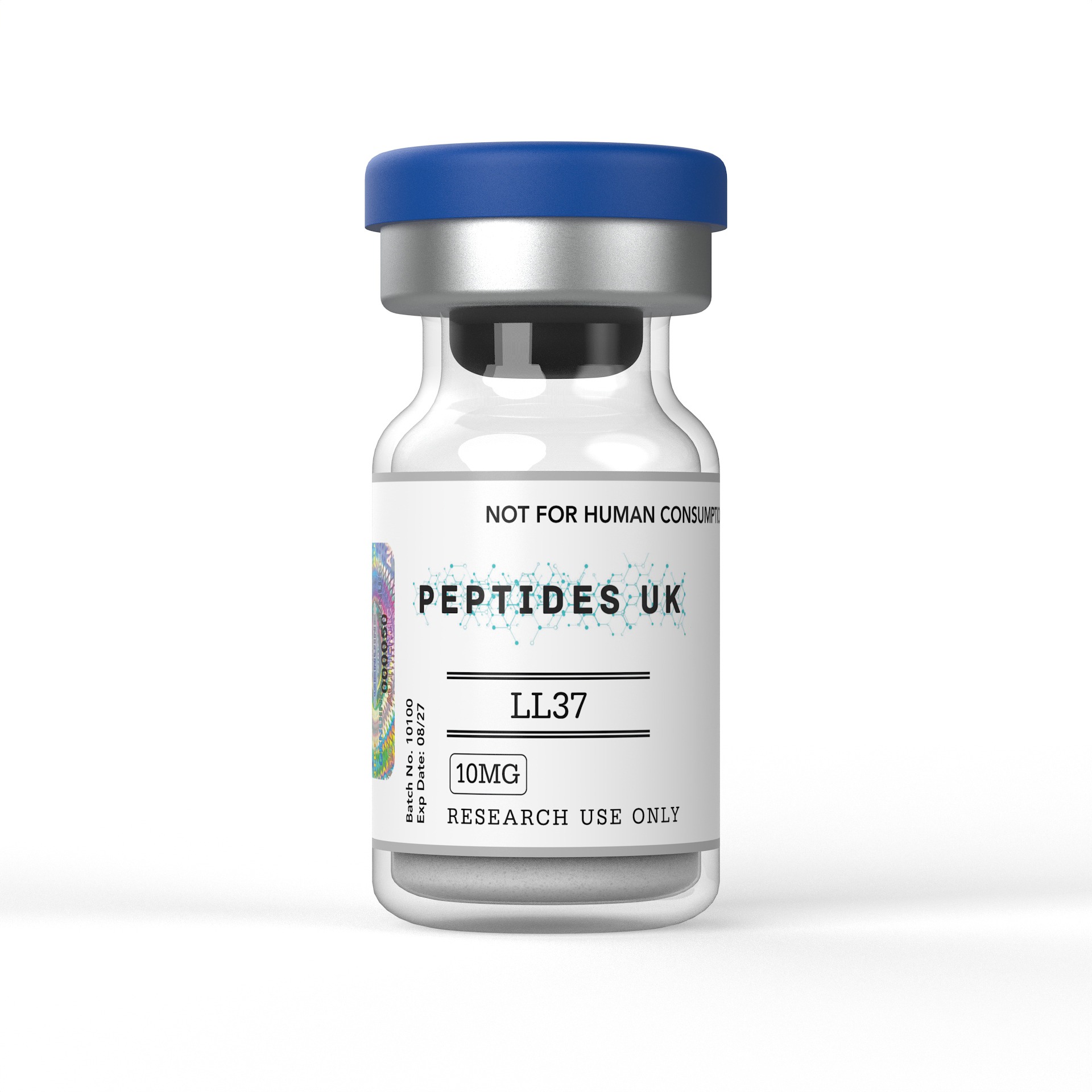
Buy LL-37 Peptide in UAE – In Stock & Ready to Ship
LL-37 is a widely researched peptide known for its role in antimicrobial activity and innate immune response studies. Each batch is independently verified at ≥99% purity and comes with a full Certificate of Analysis (COA) and HPLC testing documentation — giving UAE research teams the confidence they need when sourcing peptides for serious work.
For research use only. Not intended for human or veterinary use.

LL-37 is a 37-amino acid host defence peptide and the only known member of the human cathelicidin family, studied extensively in immunology and microbiology research for its broad-spectrum antimicrobial activity, immune modulation properties, wound healing influence, and emerging role in cancer biology — making it one of the most multifunctional innate immunity peptides currently studied in pre-clinical science. Researchers and institutions across the UAE, Dubai, Abu Dhabi and the wider GCC can source verified, research-grade LL-37 with fast international dispatch and full batch documentation included.
✅ ≥99% Purity — HPLC & Mass Spectrometry Verified
✅ Batch-Specific Certificate of Analysis (CoA) Included
✅ Sterile Lyophilised Powder | GMP Manufactured
✅ Fast International Dispatch to UAE & GCC
LL-37 is a cationic antimicrobial peptide derived from the C-terminal region of the human cathelicidin protein hCAP-18 — the sole cathelicidin expressed in humans. It is produced by neutrophils, macrophages, epithelial cells, and keratinocytes, and is found at sites of infection, inflammation, and tissue injury throughout the body. The name reflects its structure: it begins with two leucine residues and contains 37 amino acids in total.
What makes LL-37 particularly significant as a research tool is the breadth of its biological activity. While it was originally characterised for its antimicrobial properties — its ability to disrupt bacterial cell membranes through its amphipathic helical structure — subsequent research has revealed roles in immune modulation, wound healing, angiogenesis, cancer biology, and autoimmune regulation. This makes LL-37 one of the most functionally versatile innate immunity peptides available for laboratory research. Research interest from institutions across the UAE and GCC has grown alongside the broader global expansion of antimicrobial resistance research, immunology programmes, and skin biology research in the region.
In controlled laboratory and pre-clinical research settings, LL-37 has been studied across a wide range of immunological, microbiological, and biological research applications:
Antimicrobial Research: LL-37’s most studied primary mechanism is its direct antimicrobial activity against a broad spectrum of pathogens. Studies have examined its membrane-disrupting activity against gram-positive and gram-negative bacteria, fungi, and certain viruses — exploring the biophysical mechanisms through which its amphipathic helical structure interacts with and destabilises microbial cell membranes in controlled microbiological assays.
Innate Immune Modulation: Beyond direct antimicrobial activity, LL-37 is studied for its role as an immune modulator. Research has examined its influence on neutrophil, macrophage, and dendritic cell behaviour — including its effects on chemotaxis, cytokine production, and the coordination of innate immune responses in cellular infection models.
Wound Healing Research: Studies have examined LL-37’s influence on wound healing processes — including its effects on keratinocyte migration, fibroblast activity, angiogenesis, and re-epithelialisation in skin wound models — making it a relevant compound for laboratories studying the intersection of immune defence and tissue repair.
Anti-Biofilm Studies: LL-37 has been studied for its ability to disrupt bacterial biofilms — structured communities of bacteria that are significantly more resistant to conventional antimicrobial approaches. Research has examined how LL-37’s membrane-active properties affect biofilm formation and established biofilm integrity in clinically relevant bacterial models.
Angiogenesis Research: Studies have documented LL-37’s pro-angiogenic properties in wound and tissue repair models, with research examining its influence on endothelial cell behaviour, VEGF expression, and new blood vessel formation — a finding that highlights its role beyond pure antimicrobial defence.
Cancer Biology Research: LL-37 has a complex and actively studied relationship with cancer biology. Research has examined both pro- and anti-tumour effects of LL-37 in different cancer cell models — including its influence on cancer cell proliferation, apoptosis, migration, and immune evasion mechanisms — making it a relevant research tool for oncology and immunology laboratories studying tumour-immune system interactions.
Autoimmune and Inflammatory Research: LL-37 plays a documented role in certain autoimmune conditions through its ability to form complexes with self-DNA and RNA that activate innate immune receptors. Studies examining this mechanism have made LL-37 a relevant research tool for laboratories studying psoriasis biology, lupus-related pathways, and innate immune dysregulation.
Antiviral Research: Studies have examined LL-37’s activity against certain viral pathogens in pre-clinical models, exploring how its membrane-disrupting mechanism extends to viral envelope disruption and whether it influences cellular antiviral signalling pathways.
Lung and Respiratory Research: LL-37 is expressed in high concentrations in lung epithelium and respiratory fluid, and studies have examined its role in pulmonary defence mechanisms, respiratory infection models, and lung inflammation biology.
All applications listed are research-based only. LL-37 is not approved for human therapeutic use.
LL-37 has developed an extensive and multidisciplinary research profile spanning immunology, microbiology, oncology, and skin biology:
Antimicrobial research has firmly established LL-37’s broad-spectrum activity against bacteria, fungi, and viruses through membrane disruption mechanisms, with studies characterising its minimum inhibitory concentrations across a range of clinically relevant pathogens and exploring how its amphipathic helical conformation enables selective targeting of microbial versus host cell membranes. Wound healing studies have documented LL-37’s pro-healing effects across multiple tissue models, with research reporting accelerated keratinocyte migration, improved re-epithelialisation, and enhanced angiogenesis in wound assays — establishing LL-37 as an immune peptide with meaningful roles in tissue repair beyond its antimicrobial function. Cancer biology research has produced a complex and growing body of work examining LL-37’s dual roles in different cancer types — with some studies reporting anti-tumour effects through direct cancer cell cytotoxicity and apoptosis induction, while others have examined its pro-tumour roles in certain cancer microenvironments — making it an actively debated and intensively studied compound in cancer immunology research. Autoimmune research has examined LL-37’s role in activating innate immune sensors through self-nucleic acid complexes, with studies establishing a mechanistic link between dysregulated LL-37 expression and innate immune activation in psoriasis and lupus biology models — contributing significantly to the understanding of how antimicrobial peptides can drive autoimmune responses when expressed in the wrong context. Anti-biofilm research has documented LL-37’s ability to prevent and disrupt bacterial biofilm formation across multiple species — a finding of significant interest given the role of biofilms in antibiotic-resistant infection research.
| Parameter | Specification |
|---|---|
| Full Name | LL-37 (Human Cathelicidin Antimicrobial Peptide) |
| Family | Cathelicidin — sole human member |
| Length | 37 Amino Acids |
| Structure | Amphipathic alpha-helical cationic peptide |
| Purity | ≥99% (HPLC & MS Verified) |
| Form | Sterile Lyophilised Powder |
| Solubility | Sterile water, bacteriostatic water, PBS |
| Storage (powder) | -20°C, protect from light |
| Storage (reconstituted) | 2–8°C, use within 2–4 weeks |
Every order of LL-37 dispatched to the UAE and GCC includes:
Can I buy LL-37 peptide in the UAE?
Yes. We supply research-grade LL-37 with international dispatch to the UAE, Dubai, Abu Dhabi, Sharjah and across the GCC. All orders include full batch documentation and are packaged to maintain peptide integrity throughout transit. This compound is supplied strictly for laboratory research use only.
What is a cathelicidin and why is LL-37 significant?
Cathelicidins are a family of host defence peptides found across many vertebrate species — each species typically expressing one or more members. LL-37 is remarkable because it is the only cathelicidin expressed in humans, making it the sole representative of this entire antimicrobial peptide family in human biology. This uniqueness has driven significant research interest — as any insights gained from studying LL-37 are directly relevant to understanding a critical component of human innate immune defence that has no redundant family members to compensate for its loss.
Why does LL-37 have both pro- and anti-tumour properties in cancer research?
LL-37’s complex relationship with cancer biology reflects the context-dependent nature of its activity. In some cancer models, LL-37’s membrane-disrupting activity can induce direct cancer cell death and promote anti-tumour immune responses. In others, its pro-angiogenic and growth-stimulating properties — which are beneficial in wound healing — have been observed to support tumour microenvironment development. This duality makes LL-37 a particularly interesting research tool for oncology laboratories studying the relationship between innate immune peptides and cancer biology, and why its effects are studied carefully across different cancer models.
What is the significance of LL-37 in antimicrobial resistance research?
As antibiotic resistance becomes an increasingly significant global research priority, host defence peptides like LL-37 have attracted growing interest as research tools for understanding alternative antimicrobial mechanisms. LL-37’s membrane-disrupting mechanism — which does not rely on specific bacterial cellular targets the way conventional antibiotics do — makes it a relevant model compound for studying how innate immune peptides overcome bacterial resistance mechanisms, and for examining whether naturally occurring antimicrobial peptides might inform new approaches in antimicrobial research.
What purity is required for LL-37 immunology research?
A minimum of ≥98% is considered research grade, though ≥99% is strongly preferred for sensitive antimicrobial assays, cytokine measurement studies, and cancer cell biology experiments where compound purity directly affects result accuracy and reproducibility. All our LL-37 is independently verified to ≥99% purity.
How is LL-37 reconstituted for laboratory use?
Allow the vial to reach room temperature before opening. Add sterile water, bacteriostatic water, or PBS slowly down the vial wall and swirl gently without shaking. LL-37 can self-associate at high concentrations, so dissolving at lower concentrations first and then diluting to working concentration is recommended for some assays. Aliquot immediately if longer-term storage at -80°C is required to preserve peptide integrity across multiple experimental uses.
How quickly is LL-37 delivered to UAE?
Orders are dispatched promptly via tracked international courier. Delivery to the UAE typically takes 3–5 working days, with packaging designed to maintain peptide stability throughout transit.
Research Disclaimer: LL-37 is supplied exclusively for legitimate scientific research purposes conducted within licensed laboratory environments. This product is not intended for human consumption, self-administration, or any therapeutic application. It must be handled by qualified researchers in compliance with applicable UAE regulations and institutional ethics guidelines. Handling should only be performed by qualified laboratory professionals in controlled research settings with appropriate institutional authorisations in place. By purchasing, you confirm that this compound will be used solely for approved in-vitro or pre-clinical research purposes.
WhatsApp us
Receive News
