
PRODUCTS SOLD ON PEPTIDESLABUAE.COM ARE FOR RESEARCH PURPOSES ONLY AND ARE NOT FOR HUMAN OR VETERINARY USE.
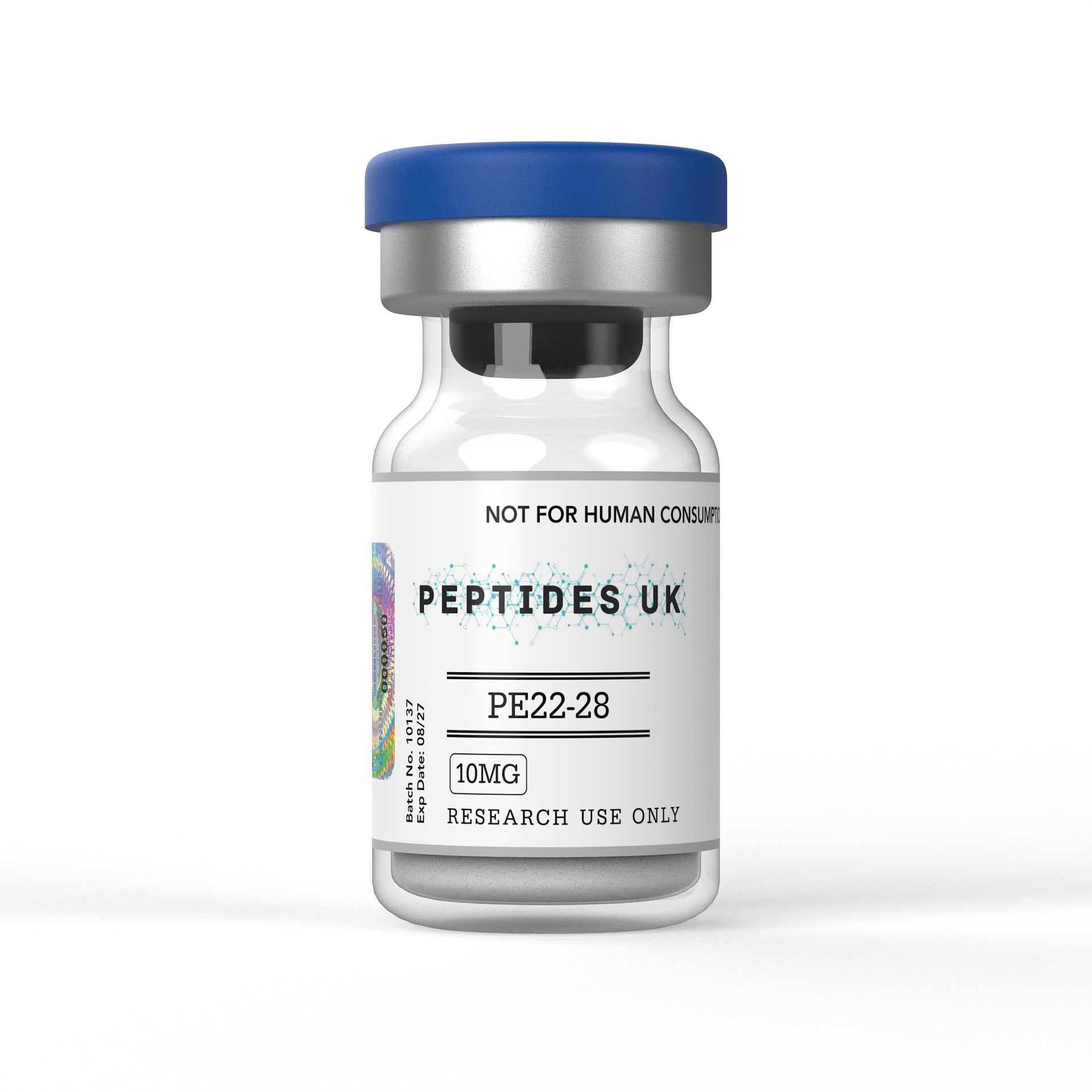
£69.00
Buy PE22-28 Peptide in UAE – In Stock & Ready to Ship
PE22-28 is a widely researched peptide known for its role in cognitive function and antidepressant mechanism studies. Each batch is independently verified at ≥99% purity and comes with a full Certificate of Analysis (COA) and HPLC testing documentation — giving UAE research teams the confidence they need when sourcing peptides for serious work.
For research use only. Not intended for human or veterinary use.

PE22-28 is one of the most specifically targeted synthetic peptides in neurological research available to laboratories in the UAE — a seven amino acid analogue of spadin that selectively blocks TREK-1 (TWIK-Related Potassium Channel 1), a two-pore domain potassium channel strongly implicated in mood regulation, neuroplasticity, and antidepressant signalling pathways, making it a highly focused research tool for studying TREK-1 channel pharmacology and its downstream effects on neural circuitry. Researchers and institutions across the UAE, Dubai, Abu Dhabi and the wider GCC can source verified, research-grade PE22-28 with fast international dispatch and full batch documentation included.
✅ ≥99% Purity — HPLC & Mass Spectrometry Verified
✅ Batch-Specific Certificate of Analysis (CoA)
✅ Sterile Lyophilised Powder | GMP Manufactured
✅ Fast International Dispatch to UAE & GCC
PE22-28 is a synthetic heptapeptide — a seven amino acid sequence — derived from and acting as a refined analogue of spadin, a naturally occurring peptide blocker of the TREK-1 potassium channel. Spadin itself is a cleavage product of the propeptide region of the sortilin receptor (neurotensin receptor 3), and was identified through research into endogenous TREK-1 channel regulators. PE22-28 represents an optimised fragment of spadin’s active sequence, engineered to retain and potentially enhance TREK-1 blocking activity while offering improved research practicality as a shorter, more defined synthetic peptide.
TREK-1 is a member of the two-pore domain potassium channel (K2P) family — background leak channels that regulate resting membrane potential and neuronal excitability. It is widely expressed throughout the central nervous system, with particularly high expression in brain regions associated with mood regulation including the prefrontal cortex, hippocampus, and raphe nuclei. Research has established TREK-1 as a significant modulator of serotonergic neurotransmission — with TREK-1 knockout models consistently displaying antidepressant-like phenotypes and enhanced serotonin signalling, positioning TREK-1 blockade as a mechanistically distinct and highly researched target in neuroscience.
PE22-28’s selectivity for TREK-1 over other K2P family members, combined with its short peptide sequence and well-defined mechanism, has made it a valuable and increasingly referenced tool in TREK-1 channel biology and neurological research.
In laboratory settings, PE22-28 research is centred on its selective TREK-1 channel blocking activity and the downstream neurological effects this produces in experimental models. Research applications include:
Its high selectivity for TREK-1 over related K2P channels makes PE22-28 a particularly clean research tool for isolating TREK-1-specific effects from broader potassium channel pharmacology — a key advantage in studies requiring mechanistic precision. All applications are for research use only.
PE22-28 has developed a focused and compelling research profile within TREK-1 channel neuroscience and neurological peptide research:
TREK-1 channel research has firmly established the channel’s role as a negative regulator of serotonergic neurotransmission — with studies in TREK-1 knockout models consistently documenting elevated serotonin levels, enhanced 5-HT receptor sensitivity, and antidepressant-like behavioural profiles, providing the foundational mechanistic rationale for investigating selective TREK-1 blockers as research tools for studying depression-related neural circuitry.
Spadin research — from which PE22-28 is derived — established proof of concept for endogenous peptide-mediated TREK-1 blockade, with studies demonstrating that spadin administration in pre-clinical models produced rapid antidepressant-like effects alongside measurable increases in hippocampal neurogenesis and BDNF expression — effects that aligned closely with the neuroplasticity changes associated with established antidepressant mechanisms.
PE22-28 analogue studies have examined whether the refined seven amino acid sequence retains and potentially improves upon spadin’s TREK-1 blocking properties — with research characterising its binding selectivity, channel blocking potency, and effects on downstream serotonergic and neuroplasticity markers in controlled pre-clinical models. These studies have positioned PE22-28 as a more defined and research-practical TREK-1 blocking tool compared to the longer native spadin sequence.
Neuroplasticity research using TREK-1 blocking peptides has explored the relationship between TREK-1 channel inhibition, BDNF upregulation, and hippocampal neurogenesis — providing insights into how potassium channel regulation of neuronal excitability connects to the broader synaptic plasticity mechanisms that underlie neural circuit adaptation in mood-related brain regions.
| Compound | Type | Target | Mechanism | Research Focus | Research Profile |
|---|---|---|---|---|---|
| PE22-28 | Synthetic heptapeptide | TREK-1 (K2P) | Channel blockade | TREK-1 pharmacology, serotonin, neuroplasticity | Growing rapidly |
| Spadin | Endogenous peptide | TREK-1 (K2P) | Channel blockade | Parent compound, antidepressant signalling | Well-documented |
| Fluoxetine | Small molecule | SERT | Reuptake inhibition | Serotonin reuptake reference | Extensively studied |
| Ketamine | Small molecule | NMDA receptor | Receptor antagonism | Rapid antidepressant mechanisms | Extensively studied |
| BDNF | Neurotrophin | TrkB receptor | Receptor activation | Neuroplasticity, neuroprotection | Extensively studied |
| Selank | Synthetic hexapeptide | Multiple | Anxiolytic signalling | Anxiety and stress pathway research | Growing |
| Parameter | Detail |
|---|---|
| Type | Synthetic Heptapeptide |
| Parent Compound | Spadin (sortilin propeptide fragment) |
| Primary Target | TREK-1 (TWIK-Related Potassium Channel 1) |
| Chain Length | 7 Amino Acids |
| Purity | ≥99% |
| Verification | HPLC & Mass Spectrometry |
| Form | Lyophilised Powder |
| Solubility | Sterile water or suitable laboratory buffer |
| Storage | -20°C, protected from light and moisture |
| Intended Use | Research use only |
Every order dispatched to the UAE and GCC includes:
Yes. We supply research-grade PE22-28 with international dispatch to the UAE, Dubai, Abu Dhabi, Sharjah and across the GCC. All orders include full batch documentation and are packaged to maintain peptide integrity throughout transit. This compound is supplied strictly for laboratory research use only.
TREK-1 is a two-pore domain background potassium channel (K2P family) widely expressed throughout the central nervous system, particularly in mood-relevant brain regions including the prefrontal cortex, hippocampus, and raphe nuclei. Research has established TREK-1 as a key regulator of neuronal excitability and serotonergic neurotransmission — with TREK-1 knockout studies consistently producing antidepressant-like phenotypes and enhanced serotonin signalling. This positions TREK-1 as one of the most mechanistically interesting targets in contemporary neurological and mood-regulation research.
Spadin is a naturally occurring peptide derived from the propeptide region of the sortilin receptor, identified as an endogenous TREK-1 blocker. PE22-28 is a synthetic analogue built from a refined seven amino acid fragment of spadin’s active sequence — designed to retain TREK-1 blocking activity in a shorter, more defined, and research-practical format. Studies have used PE22-28 to examine whether this optimised fragment maintains or enhances spadin’s pharmacological profile, making the two compounds closely linked reference tools in TREK-1 channel research.
TREK-1 channels are highly expressed on serotonergic neurons in the raphe nuclei — the brain’s primary serotonin-producing region. Research has established that TREK-1 activity regulates the excitability of these neurons, with channel blockade associated with increased serotonergic neuron firing and elevated serotonin availability in downstream brain regions. This mechanistic link between TREK-1 channel activity and serotonin output has made TREK-1 blocking peptides like PE22-28 important research tools for studying serotonergic regulation independently of classical reuptake inhibition mechanisms.
Pre-clinical studies with spadin and related TREK-1 blocking peptides have documented increases in BDNF expression and hippocampal neurogenesis alongside TREK-1 channel inhibition. Since neuroplasticity — the brain’s capacity to form new synaptic connections and generate new neurons — is a central mechanism in neural circuit adaptation, PE22-28 has become a research tool for examining how TREK-1 channel regulation connects to the broader neuroplasticity pathways that underlie adaptive changes in mood-related brain circuits.
Allow the vial to reach room temperature before opening. Add sterile water or appropriate laboratory buffer slowly down the vial wall and swirl gently without shaking. Prepare at your protocol’s required concentration. Aliquot and store at -80°C to minimise freeze-thaw degradation and maintain peptide integrity between experimental sessions.
Orders are dispatched promptly via tracked international courier. Delivery to the UAE typically takes 3–5 working days, with packaging designed to maintain peptide stability and integrity throughout transit.
PE22-28 is supplied exclusively for legitimate scientific research conducted within licensed laboratory environments. This product is not intended for human consumption, self-administration, or any therapeutic or veterinary application. It must be handled solely by qualified researchers in compliance with applicable UAE regulations and institutional ethics guidelines. By purchasing, you confirm this compound will be used exclusively for approved in vitro or pre-clinical research purposes.
WhatsApp us
Receive News
