
PRODUCTS SOLD ON PEPTIDESLABUAE.COM ARE FOR RESEARCH PURPOSES ONLY AND ARE NOT FOR HUMAN OR VETERINARY USE.
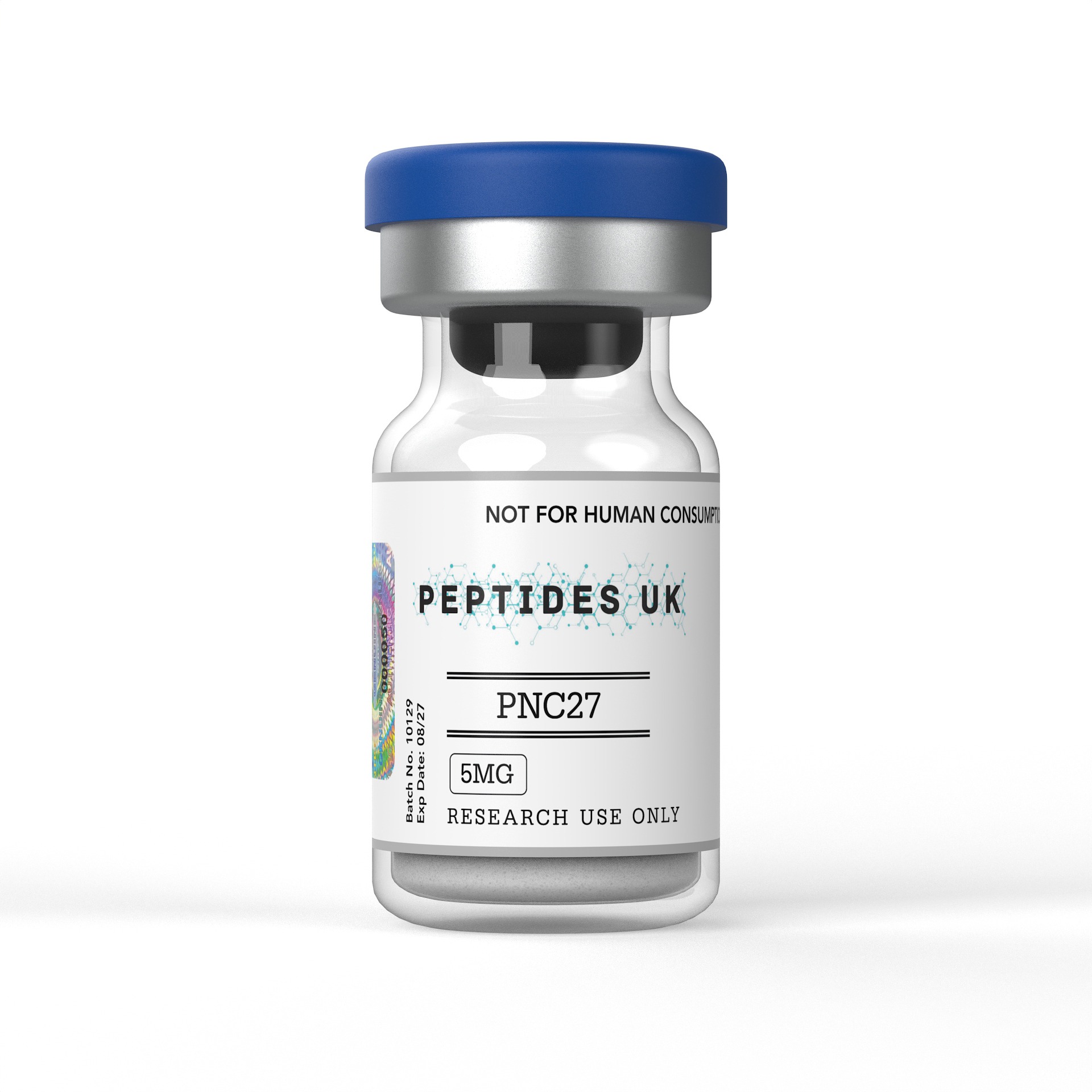
£119.00
Buy PNC-27 Peptide in UAE – In Stock & Ready to Ship
PNC-27 is a widely researched peptide known for its role in cancer cell membrane disruption and tumour biology studies. Each batch is independently verified at ≥99% purity and comes with a full Certificate of Analysis (COA) and HPLC testing documentation — giving UAE research teams the confidence they need when sourcing peptides for serious work.
For research use only. Not intended for human or veterinary use.

PNC-27 is one of the most mechanistically distinctive synthetic peptides in cancer biology research available to laboratories in the UAE — a p53-derived peptide that contains the MDM-2 binding domain of the tumour suppressor protein p53 combined with a transmembrane-penetrating sequence, enabling it to selectively target and disrupt the membranes of cancer cells that overexpress HDM-2 while leaving normal healthy cells unaffected, making it a uniquely targeted research tool for studying cancer cell selective membrane disruption, p53-MDM-2 pathway biology, and tumour suppressor-derived peptide pharmacology. Researchers and institutions across the UAE, Dubai, Abu Dhabi and the wider GCC can source verified, research-grade PNC-27 with fast international dispatch and full batch documentation included.
✅ ≥99% Purity — HPLC & Mass Spectrometry Verified
✅ Batch-Specific Certificate of Analysis (CoA)
✅ Sterile Lyophilised Powder | GMP Manufactured
✅ Fast International Dispatch to UAE & GCC
PNC-27 is a synthetic peptide derived from the p53 tumour suppressor protein — specifically incorporating the MDM-2 binding domain of p53 (residues 12–26) fused to a transmembrane-penetrating leader sequence. p53 is the most studied tumour suppressor protein in cancer biology, functioning as the cell’s primary guardian against malignant transformation by orchestrating DNA damage responses, cell cycle arrest, and apoptosis. Its interaction with MDM-2 (or HDM-2 in humans) — a negative regulator that binds p53 and targets it for proteasomal degradation — is one of the most researched protein-protein interactions in oncology science.
PNC-27’s research significance stems from its unique dual-domain structure. The p53 MDM-2 binding domain sequence allows it to interact with HDM-2 protein, which is overexpressed on the membranes of many cancer cell types but is absent or minimally expressed on the membranes of normal healthy cells. The transmembrane leader sequence enables the peptide to insert into and disrupt lipid bilayer membranes upon HDM-2 binding. The result is a cancer cell-selective membrane disruption mechanism that has made PNC-27 one of the most studied tumour suppressor-derived peptides in cancer cell biology research.
This selectivity profile — disrupting cancer cell membranes while sparing normal cells — represents a fundamentally different research approach from conventional cytotoxic mechanisms and has positioned PNC-27 as an important tool for studying selective cancer cell targeting strategies based on differential protein expression between malignant and normal cell membranes.
In laboratory settings, PNC-27 research is centred on its cancer cell selective membrane disruption activity and the underlying p53-MDM-2 pathway biology. Research applications include:
Its unique cancer cell membrane selectivity — based on differential HDM-2 expression rather than metabolic rate or non-specific cytotoxicity — makes PNC-27 a distinctly targeted research tool for studying how tumour suppressor protein domains can be exploited to achieve cancer cell selective activity in controlled laboratory models. All applications are for research use only.
PNC-27 has developed a focused and mechanistically compelling research profile within cancer cell biology and tumour suppressor peptide science:
Cancer cell selectivity research has characterised PNC-27’s differential activity against cancer versus normal cell lines — with studies documenting significant membrane disruption and cell death in multiple cancer cell line models including pancreatic, breast, leukaemia, and melanoma cell lines, alongside substantially reduced or absent activity against normal non-transformed cell lines tested under equivalent conditions. These selectivity findings have established PNC-27 as one of the most studied examples of cancer cell membrane-selective peptide activity in the research literature.
HDM-2 membrane expression research has examined the mechanistic basis for PNC-27’s cancer cell selectivity — with studies characterising HDM-2 protein expression on cancer cell membranes and its relative absence on normal cell membranes, providing the molecular explanation for PNC-27’s differential activity. This research has contributed to the broader understanding of how oncogenic transformation alters cell surface protein expression in ways that can be exploited for selective targeting strategies.
Membrane disruption mechanism studies have examined how PNC-27’s interaction with membrane-expressed HDM-2 leads to peptide insertion into the cancer cell lipid bilayer and subsequent membrane disruption — characterising the biophysical mechanism of action and distinguishing it from receptor-mediated signalling pathways or intracellular apoptotic cascades. Research has documented that PNC-27-induced cancer cell death exhibits necrotic rather than purely apoptotic characteristics — a mechanistically distinct cell death pathway that has made it a useful research tool for studying non-apoptotic cancer cell killing mechanisms.
p53-MDM-2 interaction research has used PNC-27’s binding domain sequence to study the structural requirements for p53-MDM-2 protein interaction — contributing to the broader SAR literature on p53 MDM-2 binding domain peptides and informing research into how disruption of this critical oncological protein-protein interaction can influence cancer cell biology. Pancreatic cancer cell biology research has produced some of the most referenced PNC-27 findings — with studies examining its activity against pancreatic cancer cell lines that are notoriously resistant to conventional cytotoxic approaches, positioning PNC-27 as a research tool of particular interest for studying selective targeting strategies in difficult-to-treat cancer cell models.
| Compound | Type | Mechanism | Cancer Selectivity Basis | Primary Research Focus | Research Profile |
|---|---|---|---|---|---|
| PNC-27 | p53-derived synthetic peptide | HDM-2 membrane binding + disruption | HDM-2 membrane overexpression | Cancer cell membrane disruption | Well-documented |
| PNC-28 | p53-derived synthetic peptide | HDM-2 membrane binding + disruption | HDM-2 membrane overexpression | Shorter p53 domain variant | Growing |
| Nutlin-3 | Small molecule | MDM-2 binding — p53 stabilisation | MDM-2 overexpression (intracellular) | p53 stabilisation, MDM-2 inhibition | Extensively studied |
| RITA | Small molecule | p53 binding — MDM-2 displacement | p53-MDM-2 interaction | p53 reactivation research | Well-documented |
| Stapled p53 peptides | Hydrocarbon-stapled peptides | MDM-2/MDMX binding | MDM-2/MDMX interaction | Constrained p53 peptide SAR | Growing |
| AMG-232 | MDM-2 inhibitor | Piperidinone MDM-2 binding | MDM-2 overexpression | MDM-2 inhibitor pharmacology | Growing |
| Parameter | Detail |
|---|---|
| Type | Synthetic p53-Derived Peptide |
| Domain Origin | p53 MDM-2 Binding Domain (residues 12–26) + transmembrane leader |
| Primary Target | HDM-2 membrane expression on cancer cells |
| Selectivity Mechanism | Cancer cell membrane HDM-2 overexpression |
| Purity | ≥99% |
| Verification | HPLC & Mass Spectrometry |
| Form | Lyophilised Powder |
| Solubility | Sterile water or suitable laboratory buffer |
| Storage | -20°C, protected from light and moisture |
| Intended Use | Research use only |
Every order dispatched to the UAE and GCC includes:
Yes. We supply research-grade PNC-27 with international dispatch to the UAE, Dubai, Abu Dhabi, Sharjah and across the GCC. All orders include full batch documentation and are packaged to maintain peptide integrity throughout transit. This compound is supplied strictly for laboratory research use only.
p53 is the most frequently mutated tumour suppressor protein in human cancer — functioning as a master regulator of the cellular stress response, orchestrating DNA damage repair, cell cycle arrest, and apoptosis. MDM-2 (HDM-2 in humans) is its primary negative regulator, binding to p53’s transactivation domain and targeting it for proteasomal degradation. In many cancers, HDM-2 is overexpressed, leading to excessive p53 suppression and allowing damaged cells to evade normal quality control mechanisms. The p53-MDM-2 interaction is therefore one of the most intensively researched protein-protein interactions in oncology, and compounds derived from the p53 MDM-2 binding domain — like PNC-27 — are important tools for studying this interaction’s biology.
PNC-27’s cancer cell selectivity is based on the differential expression of HDM-2 protein on cell membranes. Research has documented that HDM-2 is overexpressed on the membranes of many cancer cell types — a characteristic of malignant transformation — while normal non-transformed cells express minimal or no membrane HDM-2. PNC-27’s p53-derived binding domain interacts with this membrane-expressed HDM-2, and its transmembrane leader sequence then enables peptide insertion into the cancer cell membrane, leading to membrane disruption and cell death. Normal cells lacking membrane HDM-2 expression are not engaged by this mechanism — providing the basis for the selectivity documented in research studies.
PNC-27 and PNC-28 are closely related p53-derived peptides sharing the same transmembrane leader sequence but differing in the specific p53 MDM-2 binding domain residues incorporated. PNC-28 contains a shorter p53 domain fragment. Research comparing the two compounds has examined how these sequence differences influence HDM-2 binding affinity, cancer cell selectivity profiles, and membrane disruption potency — making them complementary SAR research tools for studying how p53 domain length and sequence influence the biological activity of MDM-2 binding peptides in cancer cell models.
Research has examined PNC-27’s activity across a range of cancer cell line models including pancreatic adenocarcinoma, breast cancer, leukaemia, and melanoma cell lines — with studies consistently documenting selective membrane disruption and cell death in cancer cells while normal cell lines showed substantially reduced sensitivity. Pancreatic cancer cell line research has been particularly referenced given the notoriously treatment-resistant nature of pancreatic cancer biology, positioning PNC-27 as a research tool of interest for studying selective targeting mechanisms in resistant cancer cell models.
Conventional cytotoxic research compounds typically kill cells through mechanisms that target rapidly dividing cells broadly — such as DNA damage, microtubule disruption, or metabolic inhibition — affecting both cancer and normal cells with differential sensitivity based primarily on proliferation rate. PNC-27’s mechanism is fundamentally different: it targets a specific protein (HDM-2) that is differentially expressed on cancer cell membranes, producing selectivity based on molecular expression differences rather than proliferation rate. This makes PNC-27 a distinctly targeted research tool for studying cancer cell selective killing strategies that operate through membrane biology rather than conventional cytotoxic pathways.
Allow the vial to reach room temperature before opening. Add sterile water or appropriate laboratory buffer slowly down the vial wall and swirl gently without shaking. Prepare at your protocol’s required concentration. Aliquot and store at -80°C to minimise freeze-thaw degradation and maintain peptide integrity between experimental sessions. Handle under standard laboratory peptide protocols with appropriate containment for research compounds.
Orders are dispatched promptly via tracked international courier. Delivery to the UAE typically takes 3–5 working days, with packaging designed to maintain peptide stability and integrity throughout transit.
PNC-27 is supplied exclusively for legitimate scientific research conducted within licensed laboratory environments. This product is not intended for human consumption, self-administration, or any therapeutic or veterinary application. It must be handled solely by qualified researchers in compliance with applicable UAE regulations and institutional ethics guidelines. By purchasing, you confirm this compound will be used exclusively for approved in vitro or pre-clinical research purposes.
WhatsApp us
Receive News
